Steel Ropes Powering Ropeways and Rail Transport
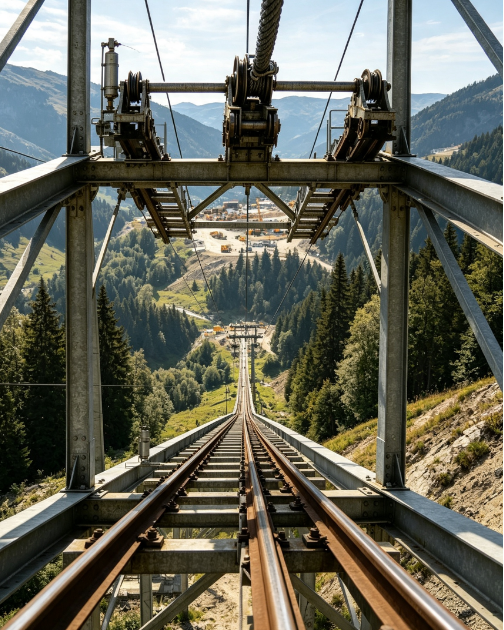
In the world of aerial ropeways and rail-bound haulage, steel wire ropes are not merely accessories — they are the essential infrastructure. From passenger cable cars ascending alpine peaks to endless-rope haulage systems moving ore deep underground, wire ropes provide the traction, support, and safety that keep these systems running.
The Carrier Rope: A Specialized Engineering Product
In aerial ropeway systems, the carrier rope, also known as the track rope, serves as the actual rail upon which transport vehicles run. This is not a task for ordinary wire rope. Industry standards specify that carrier ropes must be locked coil ropes, also called sealed wire ropes.
What makes a locked coil rope special? Unlike conventional ropes made of round wires, locked coil ropes feature an outer layer of Z-shaped, or trapezoidal, wires that interlock to form a smooth, dense cylindrical surface. This unique construction delivers several critical advantages: a density coefficient of 0.9 or higher; total breaking force up to 65 percent greater than ordinary wire ropes of the same diameter; excellent corrosion resistance as the tight surface prevents moisture ingress; and superior non-rotation properties. Typical diameters range from 20 to 70 mm. For a passenger cable car project, for instance, a 50 mm galvanized locked coil rope with a minimum breaking load of 2,800 kN is commonly specified.
For passenger ropeways, the locked coil carrier rope must comply with specific materials, manufacturing, and testing requirements for carrying ropes designed to transport persons.
Traction Ropes: The Driving Force
Alongside carrier ropes, traction ropes provide the pulling force that moves cabins or cars along the line. These ropes experience continuous bending over sheaves and drums, high-speed operation, and repeated stress cycles. Unlike carrier ropes which are static under tension, traction ropes demand exceptional flexibility and fatigue resistance. Common constructions include 6x19 or 6x36 classes with fiber or steel cores, selected based on line speed, load, and sheave diameter.
Mine Haulage: Rope-Driven Rail Transport
In underground mining, wire rope haulage systems are indispensable. Endless-rope systems use a closed-loop steel wire rope to friction-tow trains of mine cars along rails. These systems operate at rope speeds of 0.75 to 1.0 meters per second and are suitable for inclines under 20 degrees and transport distances up to 2 kilometers. More advanced rope-guided rail-gripping cars use steel wire ropes for continuous long-distance transport, eliminating the safety risks associated with multiple winch relay operations. Recent industry standards reflect the growing emphasis on safety and operational reliability in this sector.
Industry Trends: Smart Monitoring and Market Growth
The global market for steel wire ropes used in ropeways was valued at approximately 511 million USD in 2025 and is projected to reach 755 million USD by 2032. Meanwhile, the broader cable cars and ropeways market is expected to grow from 5.1 billion USD in 2025 to 9.7 billion USD by 2032.
A major trend across the industry is the integration of smart monitoring technologies. AI-powered vision systems now detect rope deviation, passenger spacing violations, and equipment anomalies in real time. Magnetic flux leakage and eddy current testing enable early detection of internal wire breaks and diameter reduction. Some systems even measure rope tension by monitoring cable angle and force distribution. These technologies shift ropeway safety from periodic manual inspection to continuous, data-driven condition monitoring.
From mountain cable car systems to deep mining haulage, wire ropes remain the backbone of ropeway and rail transport, engineered for strength, built for safety, and increasingly monitored by intelligence.