Gentle Giants in Heritage Protection
When a priceless ancient artifact needs to be moved, whether a fragile mural tomb, a centuries-old stone stele, or a submerged ancient ship, the task is nothing short of a high-stakes operation. Behind these delicate maneuvers, one piece of equipment plays a surprisingly critical role: the steel wire rope.
When Every Millimeter Matters
Unlike industrial lifting, where efficiency and speed are priorities, cultural relic lifting demands something entirely different: precision, gentleness, and absolute control. A single scratch, a slight jolt, or an uneven load distribution can cause irreversible damage to artifacts that have survived for centuries.
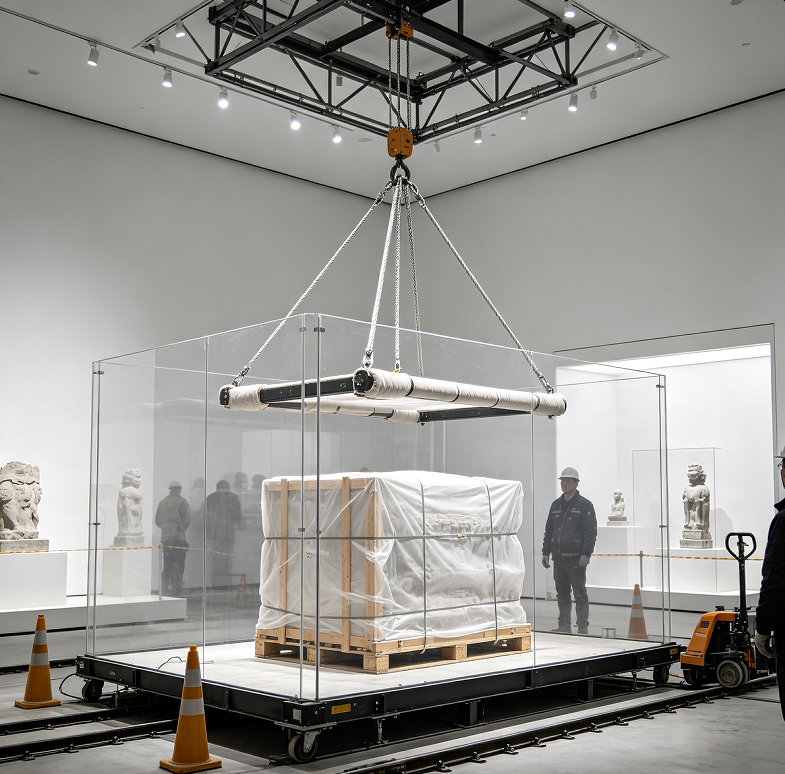
Take the relocation of a Yuan Dynasty mural tomb in Jiaozuo, China. The entire tomb chamber, measuring approximately 2.4 meters square and adorned with exquisite murals, was carefully encapsulated in a protective steel frame. Four steel wire ropes were then attached through a square steel structure, and a large crane slowly lifted the entire tomb from its original burial site, placing it onto a flatbed truck for transport to the museum. Every movement was measured, every rope tension calculated.
Similarly, when a Yuan Dynasty stone monument weighing approximately 30 tons was relocated in Jinan, engineers used eight heavy steel wire ropes attached to eight lifting points on the stele's reinforced protective shell. Before the actual lift, the team conducted over two hours of fatigue testing on every wire rope and weld to ensure zero deformation during the operation. The entire move took just six minutes, but behind those minutes were months of planning.
The Unique Demands of Artifact Rigging
What makes wire ropes for heritage applications different? Unlike standard industrial ropes, those used in artifact handling must offer exceptional flexibility to conform to irregular artifact shapes without causing pressure points. For ancient building restoration in Guangdong, specialized flexible lifting ropes were developed with bending radii as small as four times the rope diameter, a 50 percent improvement in flexibility over traditional ropes.
Surface protection is also critical to prevent scratches or contamination. Some ropes now feature cotton or hemp braided sleeves with anti-corrosion grease that is non-corrosive and won't stain valuable artifacts.
High precision is essential, with rope straightness error controlled within 0.3 mm per meter, enabling lifting accuracy of plus or minus 2 centimeters.
Corrosion resistance is another key factor, as many archaeological sites are damp or waterlogged. Galvanized or stainless steel constructions are preferred to prevent rust stains from contaminating artifacts.
From Archaeological Excavation to Museum Display
Wire ropes are indispensable not only in artifact relocation but also in excavation and museum installation. In archaeological site protection, steel wire ropes serve as support points for lifting movable pulleys when dismantling surrounding structures, effectively isolating vibration from the excavation site. For museum exhibitions, custom wire rope slings are used to lift and position heavy artifacts such as bronze ding vessels weighing over one ton or delicate porcelain pieces. Some specialized rigging systems have served over 20 museums across China, participating in the relocation of major exhibitions including the Terracotta Army and Sanxingdui artifacts.
Industry Trends: Smart and Gentle
The heritage conservation sector is embracing several key trends. Wire rope isolators for vibration-sensitive artifacts are becoming more common. A recent study on relocating a large-scale mural demonstrated how advanced wire rope isolator systems, combined with real-time vibration monitoring, can safely transport large-scale cultural heritage with minimal mechanical stress.
Customization and specialization are also growing. Unlike off-the-shelf industrial ropes, heritage applications increasingly demand bespoke solutions, ropes with specific coatings, precise lengths, and custom end fittings designed for each unique artifact.
Sustainability is another focus, with growing emphasis on environmentally friendly coatings and recyclable materials in wire rope manufacturing for heritage applications.
A Quiet Revolution
The humble wire rope may not be the most glamorous tool in the conservator's arsenal, but it is often the most critical. From lifting ancient tombs to positioning museum centerpieces, these steel strands carry the weight of history, literally and figuratively. As heritage conservation grows more sophisticated, the demand for specialized, high-precision wire rope solutions will only increase.